 ⬇️
⬇️
Key Takeaways
- Unified call analytics convert everyday voice interactions into operational, marketing, and customer-service intelligence.
- Real-time alerts, sentiment analysis, and location-level reporting can help leaders identify problems before they become visible in monthly financial results.
- Buyers should assess data quality, integrations, usability, governance, and communications reliability rather than evaluating dashboards in isolation.
Small and midsize businesses still receive thousands of consequential customer interactions by phone. Yet the information inside those calls often remains fragmented across locations, service providers, customer relationship management systems, and individual employees' notes.
That creates a familiar management problem. Leaders can see sales totals and labor costs after the fact, but they may not know how many callers abandoned the queue, which campaigns generated qualified inquiries, or why sentiment deteriorated during a particular shift. Decisions about staffing, training, and marketing then rely on intuition.
Call analytics change that equation. By collecting operational and conversational data from a unified communications environment, businesses can treat voice interactions as a source of business analytics rather than an isolated telephone function. For buyers evaluating analytics investments, this is an important shift: useful intelligence does not exist only in ERP, CRM, and financial systems.
What Unified Call Analytics Mean for Business Buyers
Unified call analytics aggregate data from calls across extensions, departments, locations, and, in some cases, digital engagement channels. They combine historical reporting with real-time monitoring to show how customers reach the business and what happens after contact begins.
As TechTarget explains, unified communications analytics can use real-time and historical VoIP data to identify patterns, forecast trends, and improve both communications tools and related business processes.
The distinction between call reporting and business analytics matters. Basic reporting might display yesterday's inbound call count. A more developed analytics application can compare volume by time and location, flag rising abandonment, analyze spoken words or sentiment, and connect call outcomes with CRM or campaign data.
A dashboard provides value by directing users toward specific actions, not simply by containing more charts.
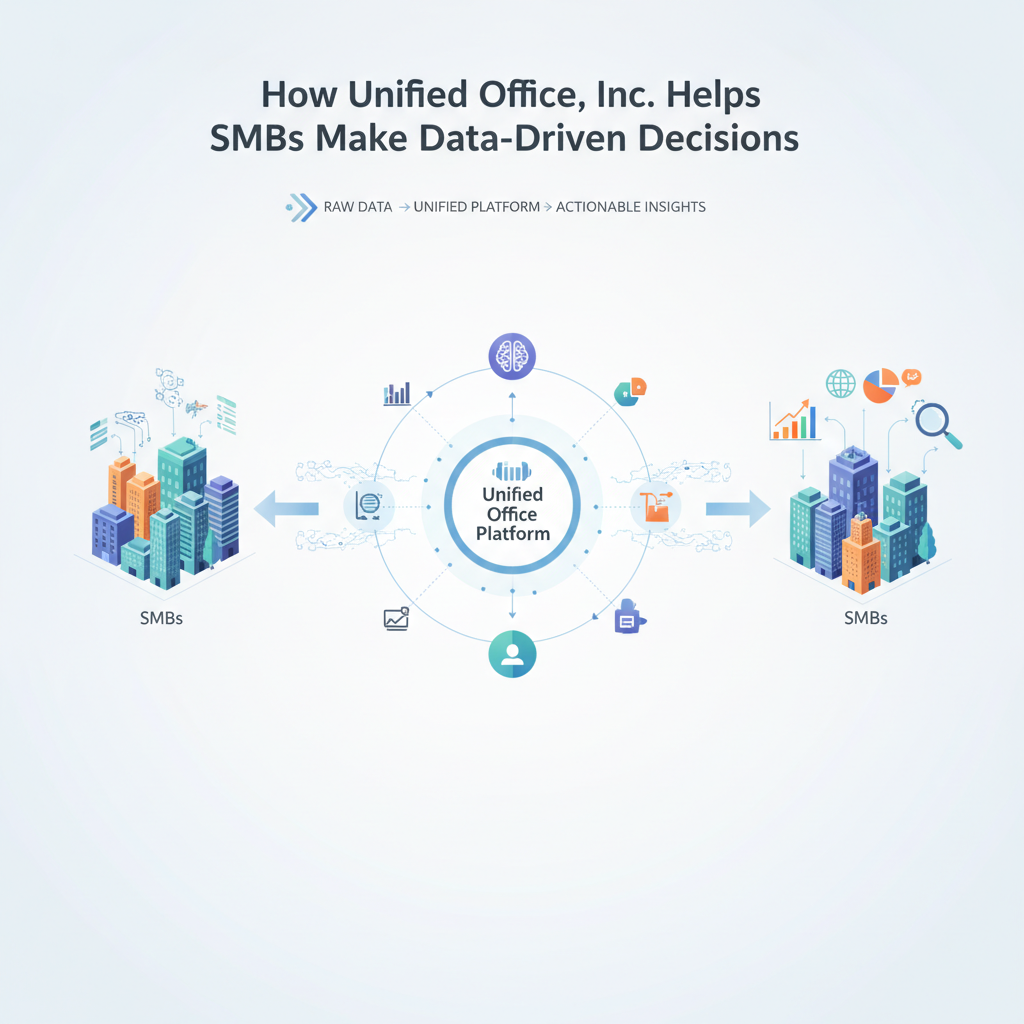
Unified Office, Inc. approaches voice as an operational data source through managed VoIP and unified communications services that include real-time business analytics, alerts, spoken-word and sentiment analysis, engagement applications, whisper coaching, and AI voice agents. That combination can be particularly relevant to distributed organizations that need a consistent view across many sites.
The Components That Turn Calls Into Actionable Data
A practical call analytics environment usually starts with operational metrics. Common measures include call volume, answer time, queue duration, abandonment rate, missed calls, transfers, and handle time. These reveal where demand exceeds available capacity or where routing rules create friction.
Conversational analytics add another layer. Speech processing can identify recurring words, topics, requests, or complaints. Sentiment analysis can help locate interactions that may warrant review, although buyers should treat sentiment scores as indicators rather than flawless judgments. Accents, background noise, industry vocabulary, and context can affect interpretation.
Real-time alerts are also significant. A manager might receive a notification when hold times cross an established threshold, several calls are missed at one location, or customer sentiment declines unusually quickly. Instead of discovering the issue in a weekly report, the business can investigate during the same operating period.
Integration completes the picture. Connecting communications data with CRM, scheduling, point-of-sale, or marketing systems can help answer more commercially useful questions:
- Which advertising sources generate calls that become appointments or purchases?
- Do longer answer times coincide with lower conversion?
- Which locations receive demand outside their scheduled staffing windows?
- What objections appear repeatedly in customer conversations?
- Are callers transferred multiple times before reaching the right employee?
Standards deserve some attention too. SIP, as defined in RFC 3261, forms the bedrock of modern IP telephony, ensuring consistent signaling across communication environments. VoIP quality guidance such as G.1011 provides a reference point for evaluating service quality. Analytics built on unreliable call delivery will offer only a partial view.
Benefits Across Operations, Marketing, and Service
For operations leaders, the immediate use case is workforce planning. A restaurant group, for example, could compare call volume and abandonment by half-hour interval across locations. If missed calls consistently increase around the dinner rush, managers could adjust schedules, modify routing, or use an AI voice agent for routine requests.
Marketing teams can use call attribution to evaluate campaigns that produce phone inquiries. Call volume alone is a weak success measure. When analytics are connected to outcomes, the team can distinguish between a campaign that generates many low-value inquiries and one that produces fewer but more qualified conversations.
Customer-service leaders gain evidence for coaching. Whisper-coach applications can provide in-call guidance, while post-call analytics can identify recurring training opportunities. Rather than reviewing a small random sample, supervisors can prioritize interactions based on topics, outcomes, or sentiment indicators.
There is a broader benefit. Shared analytics can reduce debates over whose anecdotal account is correct. Operations, marketing, and customer-service teams see the same underlying measures, even if they interpret them from different perspectives.
What happens when a regional manager can spot a service problem before customers begin posting public complaints? The organization gains time to respond. That said, analytics support judgment; they do not replace it.
How to Evaluate a Call Analytics Solution
Buyers should begin with decisions, not features. Identify specific recurring questions the organization cannot answer today, then test whether a prospective system provides the required data at the right frequency.
Data coverage is equally important. Determine whether the solution captures every location, queue, device, and relevant channel. Ask how it handles transferred calls, abandoned calls, after-hours traffic, and interactions that cross multiple systems.
Next, examine usability. Executives may need concise KPI views, while supervisors require queue-level detail and drill-down capabilities. Configurable alerts are useful when thresholds reflect actual operating conditions rather than generic defaults.
Other considerations include CRM and marketing integrations, data retention, role-based access, transcription handling, consent requirements, export options, and support for multi-location reporting. Buyers should also test communications reliability and voice quality under realistic network conditions.
Finally, run a focused pilot. Establish baseline metrics, select one operational intervention, and measure the result. A pilot might test whether revised staffing reduces abandonment or whether routing changes shorten answer times. Small experiments often reveal more than a lengthy feature checklist.
The Outlook for Voice-Based Business Analytics
Call analytics are moving from retrospective reporting toward real-time assistance and automation. AI voice agents can handle defined interactions, conversational models can surface emerging themes, and alerts can direct managers toward unusual conditions.
The next step is not simply more data. It is tighter linkage between customer conversations and business outcomes. For SMB and mid-market buyers, the opportunity is to make voice data part of everyday decision-making while retaining human review, clear governance, and realistic expectations about AI-generated analysis.