 ⬇️
⬇️
Key Takeaways
- AI analytics can turn voice, video, and messaging streams into operational signals while conversations are still underway.
- High-value use cases include live coaching, sentiment analysis, quality anomaly detection, automated summaries, and workflow triggers.
- Buyers should assess data governance, model accuracy, real-time performance, integrations, and measurable business outcomes rather than treating every AI feature as equivalent.
Definition and Overview
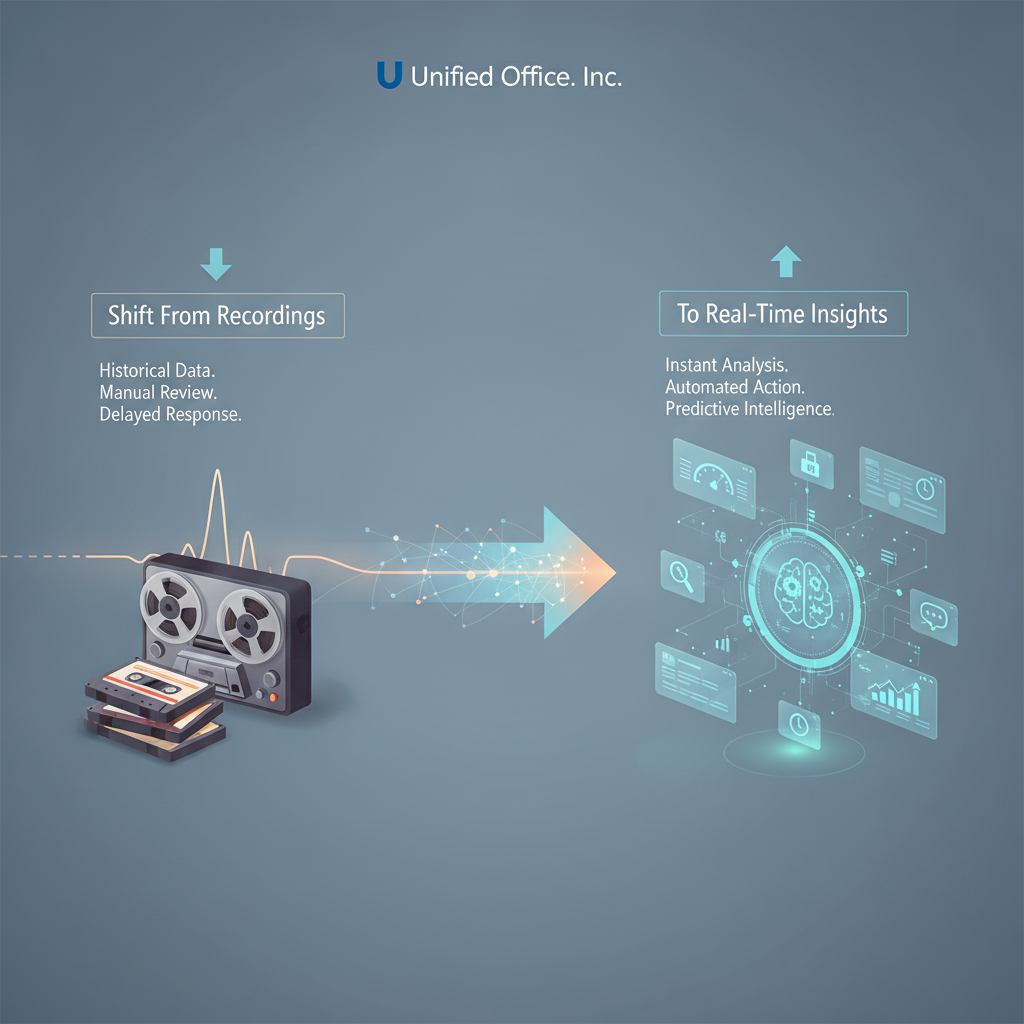
For years, enterprise communications systems captured calls primarily for compliance, dispute resolution, and occasional quality reviews. The information was technically available, but extracting value required someone to find a recording, listen to it, and interpret what happened. By then, the customer may have left, the sales opportunity may have cooled, or the service problem may have spread.
AI analytics changes that operating model. Instead of treating conversations as archived audio, it analyzes voice, video, and messaging streams as business data. Speech recognition converts spoken language into text. Natural language processing identifies topics, intent, keywords, and possible sentiment. Machine learning models can detect unusual network behavior, while automation sends the resulting insight to CRM, ticketing, workforce management, or alerting systems.
That shift matters now because communications have become distributed across offices, homes, mobile devices, contact centers, and cloud applications. According to a 2024 IDC finding, over 65% of enterprises deploying cloud communications now consider conversation intelligence and call analytics primary purchasing criteria, not optional add-ons.
Gartner projected in 2023 that 90% of UC platforms would include embedded AI for meeting transcription, summarization, and user-behavior analytics by 2027, up from less than 20% in 2022.
The Components Behind Real-Time Insight
A practical UC analytics environment relies on distinct operational capabilities.
Data capture establishes the foundation. SIP and WebRTC support real-time communications and integration across voice, browser, video, and application environments. The analytics layer then processes media streams, signaling information, call-detail records, transcripts, and relevant business context.
During the interpretation phase, spoken-word analytics can flag phrases such as "cancel my service," "speak to a manager," or a competitor's name. Sentiment analysis estimates whether an interaction is becoming more positive or negative. It is useful as a directional signal, though not as an unquestionable judgment about a person's emotional state.
The final stage involves action. An insight sitting in a dashboard may help with retrospective reporting, but a real-time alert can change the outcome of an active conversation. Unified Office, Inc. addresses this operational requirement by integrating real-time business analytics, spoken-word and sentiment analysis, whisper coaching, and AI voice agents directly into managed VoIP and unified communications.
Transcription alone is not an analytics strategy. The real value emerges when the system can connect a detected event with a useful response.
Practical Benefits and Use Cases
Live agent assistance is one of the clearest examples. If a customer mentions a billing dispute, the platform can surface an approved response, notify a supervisor, or initiate a workflow. Whisper coaching can provide guidance to an employee without interrupting the customer. This can support newer agents and promote more consistent handling of complex interactions.
Automated summaries address a less dramatic but costly problem: after-call work. A system can produce notes, identify commitments, extract action items, and populate CRM fields. McKinsey estimated in 2023 that AI-powered contact center and communications analytics could improve customer service productivity by 30% to 45% through capabilities including smarter routing, agent assistance, and automated summarization.
Quality monitoring is another strong use case, and it extends beyond customer sentiment. AI models can watch for jitter, latency, packet loss, dropped calls, device patterns, or location-specific degradation. Nemertes Research reported in 2023 that organizations using AI-based UC analytics saw a 20% to 25% reduction in mean time to resolve voice and video quality issues, supported by proactive anomaly detection and root-cause analysis.
There are revenue applications too. Sales leaders can track recurring objections, competitor mentions, pricing concerns, and next-step commitments across a larger share of calls than manual review permits. Operations teams can examine why customers call, which locations generate complaints, and whether promotions create unexpected demand.
Could a restaurant group correlate phone inquiries with staffing shortages at individual sites? Could a healthcare office detect repeated scheduling friction before complaints accumulate? In many cases, the communications stream contains those signals already. The challenge is turning them into timely, role-specific actions.
Platforms such as Microsoft Teams, Zoom, and RingCentral have helped normalize this pattern by combining recordings with transcription, keyword tracking, summaries, and links to business systems. Buyers should still examine how deeply each function operates in real time and whether it covers external calls, internal meetings, messages, and mobile interactions.
Selection Criteria for Enterprise Buyers
Start with a defined business outcome. Reducing after-call work, detecting service failures, improving appointment conversion, and supporting compliance reviews require different data, models, and integrations. A narrow initial use case often produces a clearer baseline than a broad AI initiative.
Accuracy should be evaluated using the organization's own conditions. Accents, specialized vocabulary, background noise, call compression, multiple speakers, and industry terminology can affect transcription and classification. Ask vendors how models are tested, how confidence scores are presented, and whether administrators can tune keywords or taxonomies.
Latency matters as well. A post-call summary delivered five minutes later may be perfectly useful. A coaching prompt or escalation alert arriving after the conversation ends is not.
Governance deserves equal attention. Buyers should examine consent, retention, encryption, role-based access, model training practices, biometric implications, and regional privacy obligations. NIST guidance for AI and speech-related risk management, along with ITU-T recommendations for multimedia quality and monitoring, can provide useful reference points.
Finally, inspect integration depth. Useful questions include:
- Can insights trigger CRM, ticketing, messaging, or workforce workflows?
- Does the system expose APIs and exportable data?
- Can managers trace an alert back to the transcript and recording?
- Are false positives measurable and correctable?
- Can business teams configure rules without lengthy custom development?
Future Outlook
Industry forecasts suggest embedded AI will be standard across UC platforms by 2027. Differentiation will therefore move beyond whether a product offers transcription or summaries.
The more meaningful question will be what happens next. Systems that combine reliable communications, real-time analysis, operational context, and controlled automation can help organizations respond during the moment that matters, not days after someone reviews a recording.