 ⬇️
⬇️
Key Takeaways
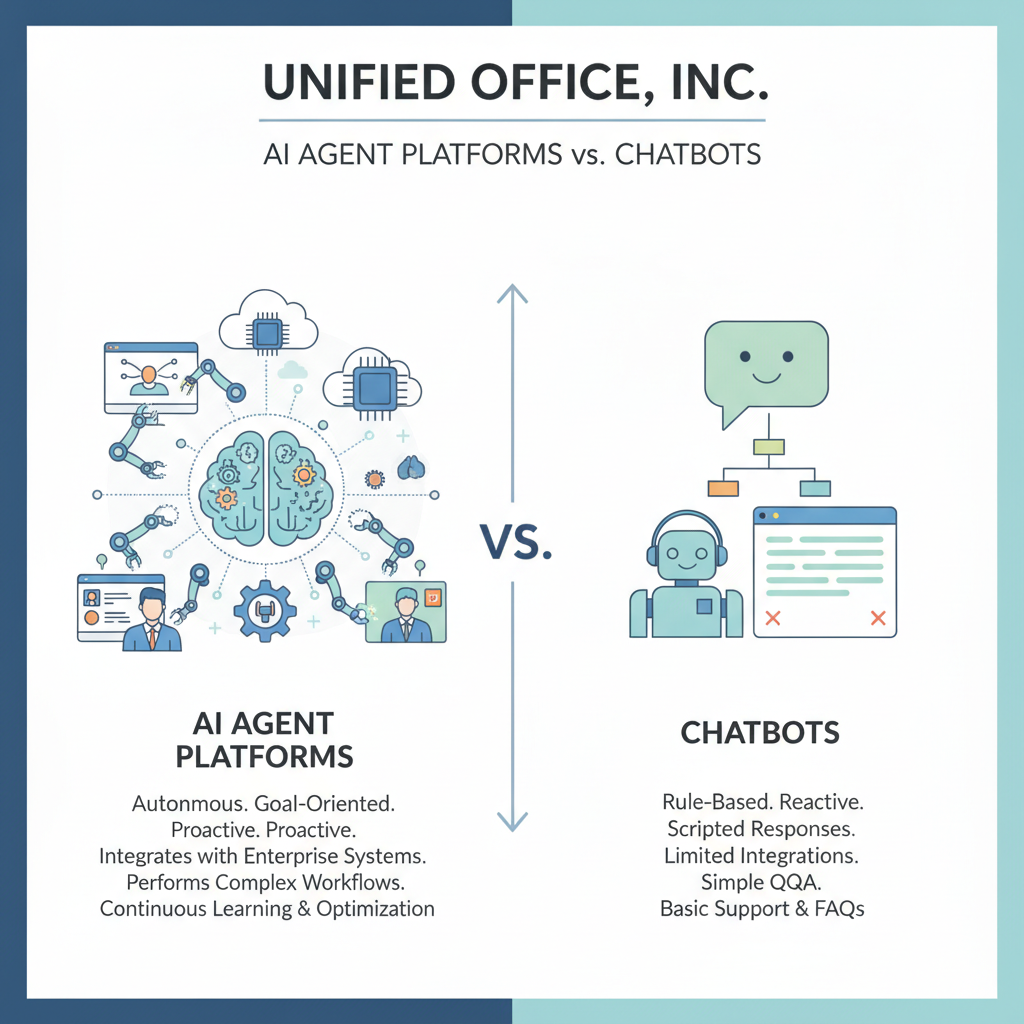
- Chatbot platforms primarily manage conversations, while AI agent development platforms orchestrate models, data, tools, and business actions.
- The larger potential return comes with additional requirements for identity, permissions, observability, testing, and human oversight.
- Buyers should begin with bounded workflows and measurable outcomes rather than selecting technology around a broad promise of autonomy.
A customer calls to change an order after shipment, asks whether a replacement is available, and wants the new delivery date confirmed. A conventional chatbot may explain the return policy. An AI agent could authenticate the caller, query inventory, update the order, arrange shipping, document the interaction in the CRM, and escalate an exception to an employee.
That difference, answering versus acting, is becoming central to enterprise automation decisions. Organizations are no longer evaluating only how naturally a system converses. They are examining what it can safely accomplish across voice, data, and operational applications.
Definition and Overview
A chatbot platform provides tools for building conversational interfaces. Traditional products rely on scripted decision trees, intents, predefined answers, or retrieval from an approved knowledge base. Newer chatbots may use large language models to produce more flexible responses, but the interaction often ends with an answer, recommendation, or handoff.
An AI agent development platform supports systems that interpret a goal, determine intermediate steps, select tools, execute approved actions, and evaluate the result. The interface could be text, voice, an employee copilot, or a background process with no visible chat window.
An LLM alone is not an agent. Agency comes from the surrounding architecture, including workflow logic, memory, API connections, authorization, monitoring, and rules governing when the system should stop or involve a person.
The distinction can blur. Intercom, Drift, and Zendesk represent the chatbot lineage, while OpenAI, Microsoft, and Salesforce have expanded the market around agent tooling and orchestration. Buyers should evaluate deployed capabilities, not product labels.
Components That Separate Agents From Chatbots
Several technical layers determine whether a platform can move beyond conversation:
- Model and reasoning support: The platform may route requests among language, speech, classification, and domain-specific models.
- Tool orchestration: Agents need controlled access to CRM, ERP, scheduling, billing, communications, and other systems.
- Read/write execution: Reading an order status carries less operational risk than changing an address, issuing a credit, or cancelling service.
- Context and memory: Useful context can include account history, prior interactions, permissions, and the current workflow state.
- Identity and access controls: OAuth 2.0 and OpenID Connect support delegated access, helping an agent act within the permissions assigned to a user or service.
- Evaluation and observability: Teams need records of prompts, tool calls, decisions, errors, latency, cost, and final outcomes.
- Human intervention: Escalation should preserve context so an employee does not restart the interaction.
These requirements become particularly important in voice environments. Speech recognition quality, interruptions, background noise, sentiment signals, and response latency can shape the outcome before workflow automation even begins.
Unified Office, Inc. addresses these voice environment requirements through managed VoIP and unified communications, real-time analytics and alerts, spoken-word and sentiment analysis, engagement applications, whisper coaching, and AI voice agents. This combination connects agent design with live business conversations.
Benefits and Practical Use Cases
The financial interest is substantial. McKinsey estimated in 2023 that generative AI and autonomous agents could contribute $2.6 trillion to $4.4 trillion in annual value across functions that include customer operations and sales. Gartner projected in 2024 that agents will handle 80% of customer service tasks by 2030, compared with roughly 30% handled today, largely through scripted and LLM-based chatbots.
In customer service, an agent might verify identity, diagnose an issue, schedule a technician, update the ticket, and send confirmation. In sales, it could analyze a call, identify an objection, surface account information, and recommend a next action to the representative. A voice agent could manage routine appointment changes while transferring sensitive or ambiguous requests.
Internal operations offer another route. Forrester reported in 2023 that 53% of global data and analytics decision-makers were investing in AI-powered automation platforms integrated with CRM or ERP systems. IDC found in 2024 that more than 60% of enterprises deploying generative AI planned to expose it through internal agent frameworks that orchestrate tools and APIs. Only 38% prioritized standalone chatbot interfaces.
Still, not every conversation needs an agent. Why give a system transaction privileges when a concise answer will do? FAQs, basic lead collection, website navigation, and simple status requests may remain economical chatbot use cases.
How Buyers Should Evaluate Platforms
Start with workflow scope. Document the trigger, data required, permitted actions, exception paths, escalation point, and system of record. A narrow process such as rescheduling an appointment is easier to test than a general instruction to resolve customer issues.
When selecting a platform, evaluate these operational capabilities:
- Integration depth: Confirm whether connectors support reliable read and write operations, not just retrieval.
- Permission granularity: Look for controls by user, role, action, record type, and transaction value.
- Governance: The NIST AI Risk Management Framework offers a useful basis for mapping, measuring, and managing risks associated with autonomous behavior.
- Channel performance: For voice, measure transcription accuracy, interruption handling, latency, transfer quality, and post-call documentation.
- Operational visibility: Ask whether administrators can replay decisions, inspect tool calls, identify failure patterns, and roll back actions.
- Economics: Model costs per completed outcome, including inference, telephony, integration, supervision, and exception handling.
- Portability: Determine how tightly workflows, prompts, data, and evaluations are tied to one model or cloud environment.
A controlled pilot can compare completion rate, escalation rate, handling time, error frequency, customer sentiment, and employee effort against the existing process. Short demos are useful. Production evidence is better.
Future Outlook
Enterprise adoption indicates a shift from conversational interfaces toward governed execution. Agent platforms are positioned to absorb more chatbot functions, while basic chatbots will continue serving low-risk, information-centered interactions.
The practical dividing line will not be whether software sounds human. It will be whether the system can complete a valuable task, explain what it did, respect its authority, and bring in a person when judgment is required.