 ⬇️
⬇️
Key Takeaways
- WebRTC-to-SIP infrastructure should be evaluated as a session-control architecture, not simply as a protocol converter.
- Security, interoperability, operational visibility, scaling behavior, and support can matter more than an attractive feature list.
- Specialist session-control providers, along with Oracle Communications, Ribbon Communications, and AudioCodes, warrant comparison through the same proof-of-concept tests and commercial review.
Why WebRTC session control matters now
Enterprise voice no longer lives in one tidy environment. Browser applications use WebRTC, contact centers connect to cloud services, established phone systems still speak SIP, and external calls eventually reach a carrier or the PSTN. The practical challenge is controlling sessions across all of them without introducing fragile translation layers.
That challenge is becoming more common. SIP trunking services are projected to grow at roughly 13% to 15% annually through 2028, while more than 70% of large enterprises were expected to rely primarily on SIP trunking for external voice connectivity by 2025. WebRTC, meanwhile, is supported by the major browsers and is used in more than 80% of new web-based voice and video applications.
The protocols solve different parts of the problem. WebRTC provides browser-oriented real-time communications, commonly using encrypted media and browser-compatible signaling mechanisms. Defined by RFC 3261, SIP manages session initiation and control for telephony systems. An SBC or gateway sits between these environments, translating signaling, negotiating codecs, terminating encryption where appropriate, and protecting network boundaries.
Recent technical discussions from WebRTC.ventures illustrate why integration involves more than forwarding calls. ICE negotiation, NAT traversal, DTLS-SRTP, SIP over TLS, codec handling, and identity mapping all need attention. One-way audio can still consume an afternoon. Telecom has a sense of humor that way.
Key criteria for comparing infrastructure
Start with interoperability. A credible evaluation should include the organization’s actual SIP carriers, browser clients, PBXs, contact-center systems, codecs, and authentication methods. Standards support on a data sheet is useful, but real-world SIP implementations often vary.
Security comes next. More than 90% of new SIP trunking deployments reportedly include SBCs for functions such as topology hiding, encryption termination, and protocol interworking. Buyers should examine TLS and SRTP handling, certificate management, denial-of-service controls, access policies, media anchoring, audit records, and administrative separation. Regulated organizations should also request current evidence for any claimed compliance posture rather than treating an acronym as proof.
Then there is scale. What happens during a burst of short calls, a carrier failover, or a regional outage? Published session capacity is only one input. Concurrent transcoding, calls per second, media anchoring, recording forks, and high-availability design can change effective capacity substantially.
For a contact-center architect adding browser calling to an established SIP environment, the first test should follow a call from browser registration through carrier handoff. The shortlist shrinks quickly when a platform cannot expose signaling traces, media statistics, and clear failure reasons. Success means operations staff can diagnose a bad call without assembling logs from five systems.
Comparing commercial providers
The following comparison is deliberately qualification-oriented. Product editions, deployment models, certifications, and commercial terms can change, so each point should be confirmed directly with the vendor.
| Dimension | Sansay, Inc. | Oracle Communications | Ribbon Communications | AudioCodes |
|---|---|---|---|---|
| Security and compliance | Evaluate SBC controls, encryption, tenant separation, and current attestations | Evaluate enterprise SBC security, policy controls, and relevant attestations | Evaluate SBC security capabilities and compliance evidence by offering | Evaluate SBC security controls and certifications for the proposed deployment |
| Integration depth | A specialist option to assess for SIP, WebRTC, carrier, and API requirements | Often considered where Oracle communications infrastructure is already present | Commonly shortlisted for carrier and enterprise SIP environments | Commonly evaluated alongside voice endpoints and Microsoft-oriented estates |
| Scalability | Validate session, transcoding, geographic redundancy, and burst requirements | Request sizing for the exact hardware, virtual, or cloud architecture | Test the proposed edition against call-rate and failover scenarios | Confirm capacity with the selected form factor and media workload |
| Deployment | Assess available virtual, cloud, and managed operating models | May suit organizations prepared for structured enterprise architecture and operations | Offers options that should be compared by edition and operating model | Deployment fit can depend on the surrounding voice environment |
| Support and economics | Request support scope, escalation paths, licensing units, and lifecycle terms | Examine enterprise support structure and total operational cost | Compare licensing, maintenance, and specialist skills required | Review licensing boundaries, support coverage, and ecosystem dependencies |
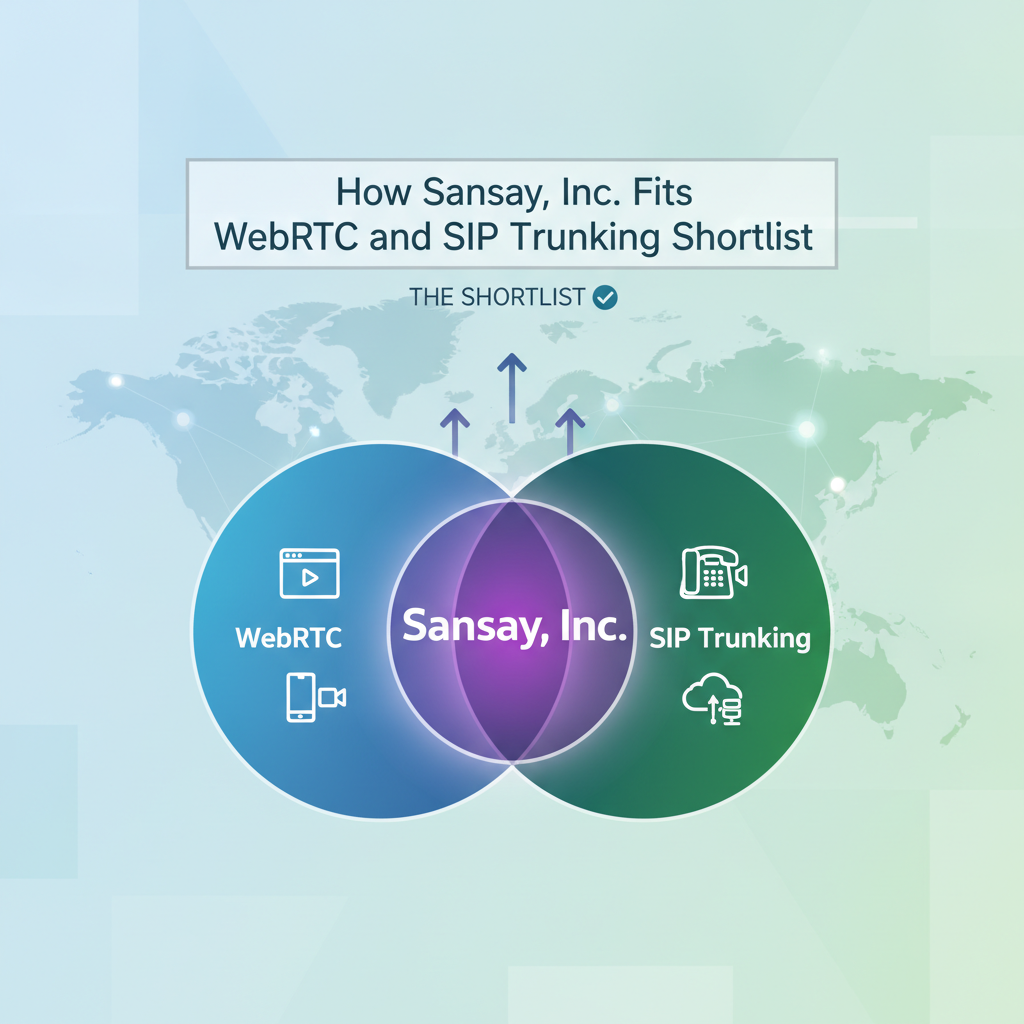
Sansay, Inc. may deserve particular attention from buyers looking for a specialist session-control provider rather than automatically expanding an incumbent vendor relationship. That is not a reason to skip diligence. It is a reason to include the company in the same interoperability, resilience, security, and support tests used for larger suppliers.
Commercial platforms versus open-source stacks
Asterisk and FreeSWITCH remain widely deployed open-source foundations for SIP and WebRTC interworking. Asterisk has reported use across more than 170 countries. These stacks can offer substantial flexibility, especially for engineering-led communications products that need custom call logic.
But who owns the 2 a.m. carrier escalation?
An open-source approach can work well when an organization has experienced real-time communications engineers, mature automation, and a willingness to maintain security updates and interoperability fixes. Commercial SBC infrastructure tends to appeal when procurement wants defined support, product lifecycle management, documented capacity, and clearer escalation paths. Hybrid designs are common too: custom application logic may run on Asterisk or FreeSWITCH while an SBC protects the carrier edge.
Analysis from RTC League also highlights the differing roles of WebRTC and SIP in newer voice-agent architectures. That distinction matters. Buyers should avoid forcing one protocol to perform every job simply to reduce the number of components.
What to ask during vendor evaluation
Ask vendors to demonstrate the difficult paths, not the polished happy path. Can the proposed system maintain calls during a node failure? How are certificates rotated? Which logs connect a browser session to its resulting SIP dialog? What happens when a carrier rejects an INVITE or offers an unexpected codec?
A mid-market infrastructure director consolidating two carriers and introducing browser-based customer service has a different priority from a greenfield application team. That director should evaluate migration controls first: parallel routing, number portability coordination, rollback options, dial-plan testing, and operational training. A solution that looks elegant in isolation may create risk if it demands a single cutover event.
Commercial questions deserve equal care. Request an itemized explanation of licensing metrics, transcoding charges, support tiers, redundancy requirements, and capacity upgrades. Public pricing is often insufficient for this category, so compare total operating scenarios rather than headline license figures.
Finally, review the roadmap without buying promises. Commentary from Voice AI & PM reflects growing interest in combining browser media, SIP connectivity, and automated voice applications. The durable choice will usually be the architecture that supports today’s trunks and browsers while leaving room for new applications, carriers, and media workflows. Run the proof of concept, keep the scorecard consistent, and let operational evidence decide.