 ⬇️
⬇️
Key Takeaways
- Mobile WebRTC requires more than browser-based media. Enterprises need coordinated signaling, security, policy enforcement, NAT traversal, and interoperability with SIP and carrier networks.
- Buyers should evaluate session control as an operational architecture, not a single product feature, with particular attention to scale, observability, failure handling, and deployment flexibility.
- A successful strategy connects customer experience goals with measurable technical requirements, including call completion, media quality, security controls, and support for changing mobile conditions.
Executive Summary
Mobile applications are becoming primary service channels for banking, healthcare, retail, field operations, and customer support. Adding an audio or video button is relatively straightforward. Delivering a reliable session when a user moves between Wi-Fi and cellular networks, sits behind restrictive network address translation, or connects to a legacy contact center is considerably harder.
That gap explains the renewed focus on WebRTC session control infrastructure. The control layer coordinates signaling, negotiation, security, routing, policy, and interoperability while helping operations teams understand what happened when a session failed.
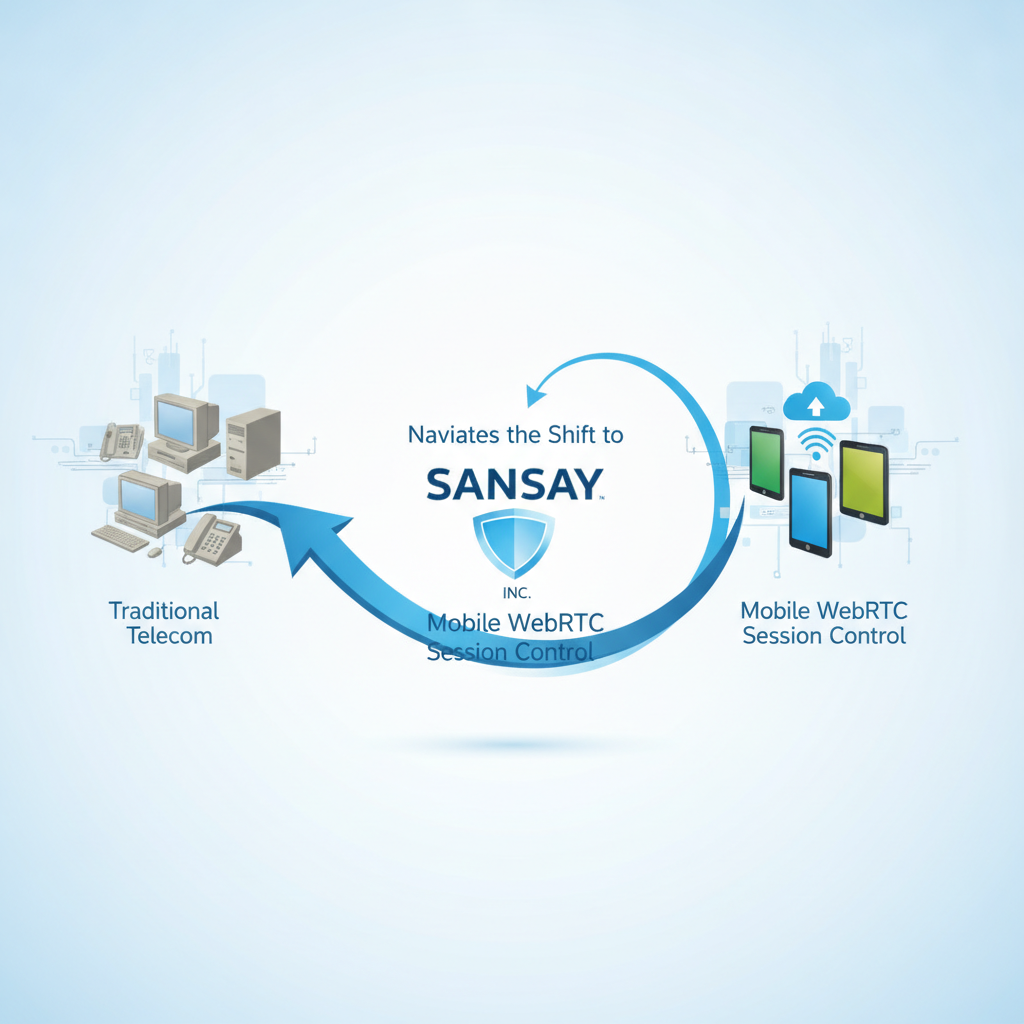
Enterprise buyers are therefore looking beyond basic WebRTC support. They are comparing WebRTC gateways, session border controllers, SIP infrastructure, and cloud communications services as parts of a broader architecture. Providers such as Sansay, Inc. address these infrastructure requirements by supplying the session border control and signaling gateways necessary to tie these disparate environments together alongside other established communications vendors.
The practical objective is not simply to deploy WebRTC. It is to create a manageable real-time communications service that behaves predictably across mobile devices, access networks, cloud environments, and existing voice platforms.
Why Mobile WebRTC Is Becoming an Infrastructure Decision
Global mobile data traffic is projected to reach 270 exabytes per month by 2029, according to the Ericsson Mobility Report. Video and other real-time applications account for much of that growth. At the same time, Gartner projects that 74% of customer interactions will be digital by 2027.
These trends meet inside the mobile application. A customer may initiate an authenticated voice conversation from a banking app, escalate a support chat to video, or contact a clinician without dialing a traditional telephone number. WebRTC can expose media capabilities, but it does not by itself provide an enterprise operating model.
Yet media transmission is only one component of the session architecture.
The infrastructure also has to authenticate users, exchange offers and answers, select codecs, traverse NAT and firewalls, enforce routing policy, and connect sessions to SIP trunks, contact-center platforms, or mobile network services. What happens when a browser speaks WebRTC while the destination still expects SIP? That is where gateways, SBCs, and session control services earn their place.
WebRTC commonly uses ICE for connectivity establishment and DTLS-SRTP for encrypted media. SDP and JSEP support offer-and-answer negotiation, while signaling is often carried through WebSocket or HTTP-based mechanisms. These components are standards-based, yet implementation details vary. Small differences in codec handling, session timers, certificates, or candidate selection can become production problems.
Building the Right Session Control Architecture
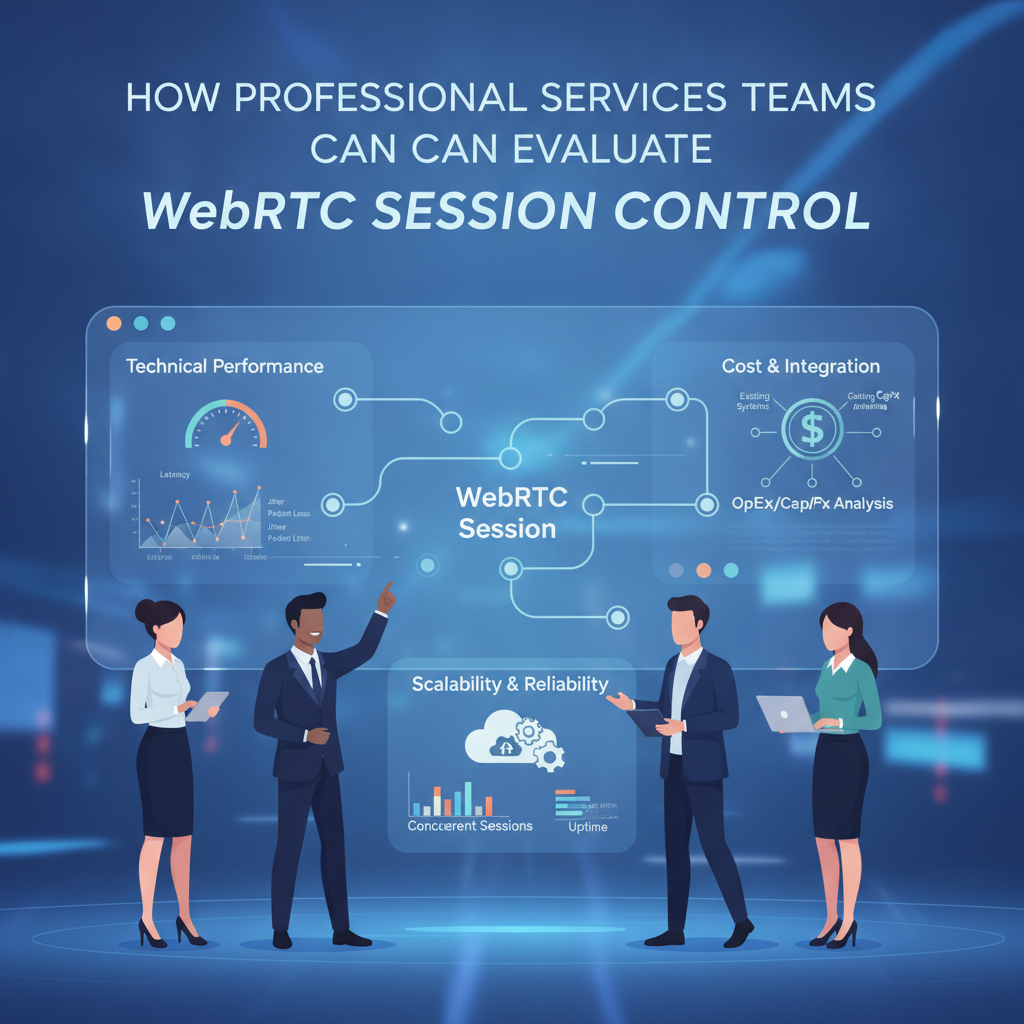
A useful evaluation begins with traffic flows rather than product categories. Buyers should map where users connect, where signaling terminates, whether media stays peer-to-peer or passes through controlled infrastructure, and how sessions reach existing communications systems.
Consider a contact-center technology director adding in-app calling for customers across several regions. The first evaluation question is not how many WebRTC acronyms a platform supports. It is whether the architecture can preserve customer context, route sessions into the correct queue, interoperate with the current SIP environment, and expose enough telemetry to diagnose failed connections. A shortlist that lacks regional deployment options or clear session-level observability would shrink quickly.
Security deserves similar specificity. DTLS-SRTP provides media protection, but enterprises also need to examine identity, signaling authentication, certificate management, denial-of-service controls, topology hiding, and administrative access. An SBC can provide an enforcement boundary between WebRTC, SIP, carrier, and enterprise domains. Still, buyers should verify which controls apply to signaling, media, and management traffic rather than assuming the SBC label answers every question.
Scale is more nuanced than concurrent-session capacity. How quickly can the control layer absorb connection bursts after a mobile notification or service outage? Can signaling and media resources scale independently? Does failover preserve active sessions, or only allow new ones to connect?
Market growth adds urgency. IDC forecasts that the broader cloud communications and CPaaS market will exceed $40 billion in revenue by 2028, with carrier and enterprise WebRTC deployments expanding at a double-digit compound annual growth rate. More usage means more dependencies, and more operational scrutiny.
Turning Requirements Into an Implementation Plan
Start with a small set of representative journeys. Test an authenticated in-app call, a video escalation, a transfer into a SIP contact center, and a session initiated on a weak cellular connection. Then introduce difficult conditions: roaming, packet loss, restrictive firewalls, expired credentials, and regional service interruption. Clean lab tests are useful, but mobile reality is messy.
A network architect supporting a field-service workforce faces a different scenario. Technicians may move among private Wi-Fi, public networks, and LTE or 5G during a live session. That architect should prioritize ICE behavior, TURN capacity, reconnection logic, codec adaptation, and visibility into network transitions. A solution that performs well only on managed office networks would not survive the shortlist. Success looks like understandable failure behavior as much as pristine call quality.
Operational ownership also needs attention. Who manages certificates? Who investigates failed offer-and-answer exchanges? Who controls routing changes after hours? If the communications team, application team, and security team each see only part of the transaction, incident resolution can stall.
That said, deployment does not have to begin as a large transformation. Many organizations introduce WebRTC at an edge boundary, integrate it with an existing SIP core, and expand after validating interoperability and operating procedures. The ITU Telecommunication Standardization Sector provides relevant guidance for next-generation and packet-based communications architectures, including the carrier-grade considerations surrounding quality, security, and interconnection.
Procurement should also examine commercial architecture. Licensing based on sessions, ports, bandwidth, instances, or subscriptions can produce very different costs as usage changes. Buyers benefit from modeling normal demand, seasonal peaks, geographic expansion, and redundancy rather than comparing a single headline price.
What Enterprise Buyers Should Watch Next
WebRTC session control is likely to become more distributed. Application signaling may run in public cloud regions, media services may sit closer to users, and SIP interconnection may remain in established carrier facilities. This creates a hybrid control problem, not merely a cloud migration exercise.
Embedded communications will also blur the boundary between the application and the contact center. Identity, customer context, conversation routing, and media policy will increasingly travel together. Can the infrastructure preserve that context without exposing sensitive application data to every downstream system?
Meanwhile, 5G can improve capacity and latency, but it does not remove endpoint diversity, NAT traversal, policy, or interoperability concerns. Carrier-grade WebRTC will continue to depend on coordinated gateways, SBC functions, SIP cores, and service monitoring.
Conclusion
Mobile WebRTC can make voice and video feel like natural parts of a digital journey. Behind that simple experience sits a demanding infrastructure problem involving signaling, media negotiation, encryption, network traversal, policy enforcement, and legacy integration.
Enterprise and mid-market buyers should begin with real user journeys, map the full session path, and define success in operational terms. Completion rates, setup time, media quality, failover behavior, and diagnostic depth are more revealing than a long protocol checklist.
The strongest evaluations also test adverse mobile conditions and clarify ownership across application, communications, network, and security teams. WebRTC session control is not just a browser capability. Increasingly, it is part of the enterprise communications control plane, and it deserves the same architectural discipline applied to other business-critical services.