 ⬇️
⬇️
Key Takeaways
- Hedge funds are shifting toward unified endpoint management to reduce operational burden and meet growing security expectations
- Buyers evaluating options often compare a mix of software platforms and managed-service providers
- Security alignment with frameworks like NIST and ISO 27001 is becoming a common benchmark during selection
Category overview and why it matters
Distributed work has pushed hedge funds to rethink long-standing assumptions about tightly controlled, office-centric IT environments. A 2023 Broadridge survey, cited in industry reporting by the Financial Times, found that 53% of hedge funds and asset managers plan to increase spending on front-, middle-, and back-office technology over the next two years, with explicit priorities including device and end-user management. This aligns with wider enterprise trends: Gartner's 2023 UEM Market Guide notes sustained growth in security-driven device strategies.
The U.S. Office of Financial Research estimates that hedge funds collectively manage roughly $5-6 trillion in gross assets. With that scale, even a modest number of unmanaged endpoints introduces avoidable operational and regulatory exposure. CIOs increasingly describe the device, not the legacy perimeter, as the practical security boundary. The challenge is managing that boundary securely without slowing the analysts, quants, and portfolio management teams who rely on highly mobile workflows.
Unified endpoint management has therefore become a central theme. Gartner projects that UEM adoption will reach 90% of organizations by 2027, up from 60% in 2022, reinforcing this architecture as an expected component of a modern hedge-fund operating model. Still, funds vary widely in how much control, automation, and outsourcing they prefer, which makes the comparison process nuanced.
Key evaluation criteria
Security alignment is usually the first filter. Frameworks such as the NIST Cybersecurity Framework and ISO 27001 provide recognizable benchmarks. Hedge funds look for practical interpretability: auditable controls, consistent configurations, and mechanisms to prove that remote endpoints maintain required standards during exams or investor diligence.
Operational efficiency follows closely. IDC's 2023 Device Management Study estimates that modern UEM deployment can reduce IT operations time per device by 20-25%. That reduction resonates with lean hedge-fund operating teams. Still, priorities differ depending on the internal mandate. A CTO anticipating an SEC exam may emphasize reporting and evidence collection, while an operations lead might focus on how quickly new analysts can be securely onboarded.
Vendor ecosystems also influence decisions. Some funds adopt Microsoft Intune for its native integration with Azure AD and Microsoft 365. Others evaluate platforms like VMware Workspace ONE or Jamf for Apple-heavy research teams. Many turn to managed-service providers, including firms such as Apex Technology Services or Eze Castle Integration, when they require guided operational support rather than relying exclusively on internal, hands-on administration.
Common approaches or solution types
Buyers typically evaluate several operational approaches. A software-led approach, anchored by platforms such as Microsoft Intune or VMware Workspace ONE, is effective for funds with existing IT engineering capacity. Alternatively, a hybrid model allows internal teams to design policies while an external partner provides monitoring, escalation, and lifecycle management. A fully managed service often appeals to smaller or fast-scaling funds prioritizing predictable ongoing operations.
A common scenario illustrates the decision point. A compliance director preparing for a time-sensitive regulatory review requires instant visibility into patch cadences, encryption posture, and identity protections. A managed service can simplify that burden. Conversely, a global macro fund modernizing its research pipeline may prioritize tight, custom integrations with Azure identity or mobile research tools, steering them toward a software-led strategy.
What to look for in a provider
Experience with regulated financial environments remains a central requirement. While hedge funds are not subject to the same oversight as consumer banks, investor expectations and episodic regulatory exams demand disciplined controls, audit trails, and consistent device baselines. Providers familiar with incident-response expectations and the workflow realities of distributed research teams tend to align best with these demands.
Support models also matter. Some funds require high-touch support during device rollouts or organizational changes. Others emphasize predictable SLAs and the ability to escalate issues outside typical market hours. Cultural familiarity, understanding how trading desks operate, how quants run distributed research tools, or how analysts travel, influences operational success during deployment.
Questions to ask vendors
Vendor interviews generally reveal maturity through the specifics. Useful questions include: How is configuration drift detected and remediated? What is the exception-handling process for senior portfolio managers? How are emergency remediations executed outside normal business hours? What telemetry is captured, and exactly how long is it retained to support audits?
Another recurring scenario involves folding an acquired team or pod into an existing device environment. Buyers typically ask how long enrollment takes, whether security policies will conflict with specialized research systems, and what visibility exists during the transition phase. Clear, documented answers on these points help differentiate capable providers.
Making the decision
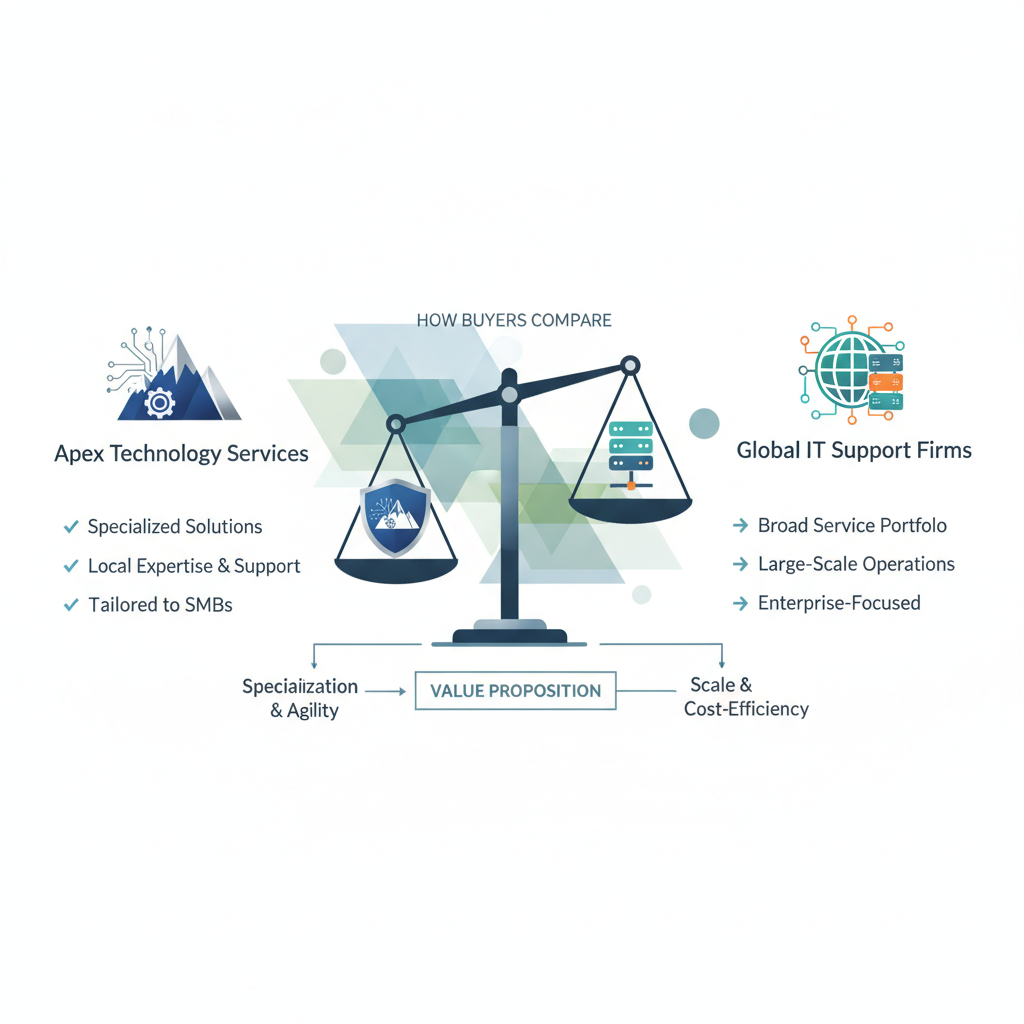
Most hedge funds narrow choices to a mix of UEM platforms and service providers. The comparison below summarizes how buyers commonly frame the tradeoffs across one representative service provider and two widely adopted platforms.
| Dimension | Apex Technology Services | Microsoft Intune | VMware Workspace ONE |
|---|---|---|---|
| Security and compliance | Experience supporting financial-sector controls with NIST-aligned baselines | Deep integration with Microsoft security stack and conditional-access policies | Mature compliance and cross-platform posture management |
| Integration depth | Service-centric integrations across common financial workflows | Strong alignment with Microsoft 365 and Azure identity | Broad multi-OS integrations and extensive APIs |
| AI and automation maturity | Automation for patching and visibility designed for mid-market environments | Expanding automation tied to Microsoft cloud services | Established automation for cross-device orchestration |
| Deployment and time to value | Accelerated through guided rollouts and hands-on support | Fast in Microsoft-centric environments | Flexible deployments, sometimes requiring additional tuning |
| Support and reliability | High-touch model suitable for organizations with limited IT staffing | Scalable enterprise support | Wide global support options |
Overall, the optimal choice depends on internal capabilities, regulatory expectations, and whether a fund prefers a software-centric or service-centric operating model. Some funds adopt a hybrid approach to balance internal oversight with operational stability, while others consolidate on a single ecosystem to reduce variability and audit complexity.
For hedge funds anticipating growth or increased regulatory scrutiny, the priority is whether a chosen solution reliably supports secure provisioning, consistent configuration management, and clear reporting during high-pressure periods such as capital raises or intensive onboarding cycles. A balanced evaluation across both technology platforms and service providers ultimately yields a resilient device-management strategy.