 ⬇️
⬇️
Key Takeaways
- Start with one high-value workflow, such as privileged EHR access, and enforce identity, device-posture, and context checks through an identity provider and conditional-access engine.
- Use HL7, FHIR, syslog, and REST API integrations to connect clinical applications, security telemetry, and policy enforcement rather than treating zero trust as a standalone product.
- Track observable measures such as blocked unmanaged-device sessions, privileged-access exceptions, network paths between medical-device VLANs, and mean time to revoke third-party access.
Define the Clinical Problem Before Evaluating Products
A clinician signs in to an electronic health record from a managed workstation, moves to a shared clinical terminal, and later reviews a result remotely. Each session presents a different combination of user identity, device ownership, network location, patient data, and clinical urgency.
A conventional perimeter model may treat all three sessions as trusted once they originate from an approved network. A zero-trust design evaluates each request using signals such as multifactor authentication status, endpoint encryption, device health, user role, application sensitivity, and current session behavior.
The goal is not to place another login screen between clinicians and patients. It is to distinguish normal access from unusual access with enough precision that controls do not interrupt routine care.
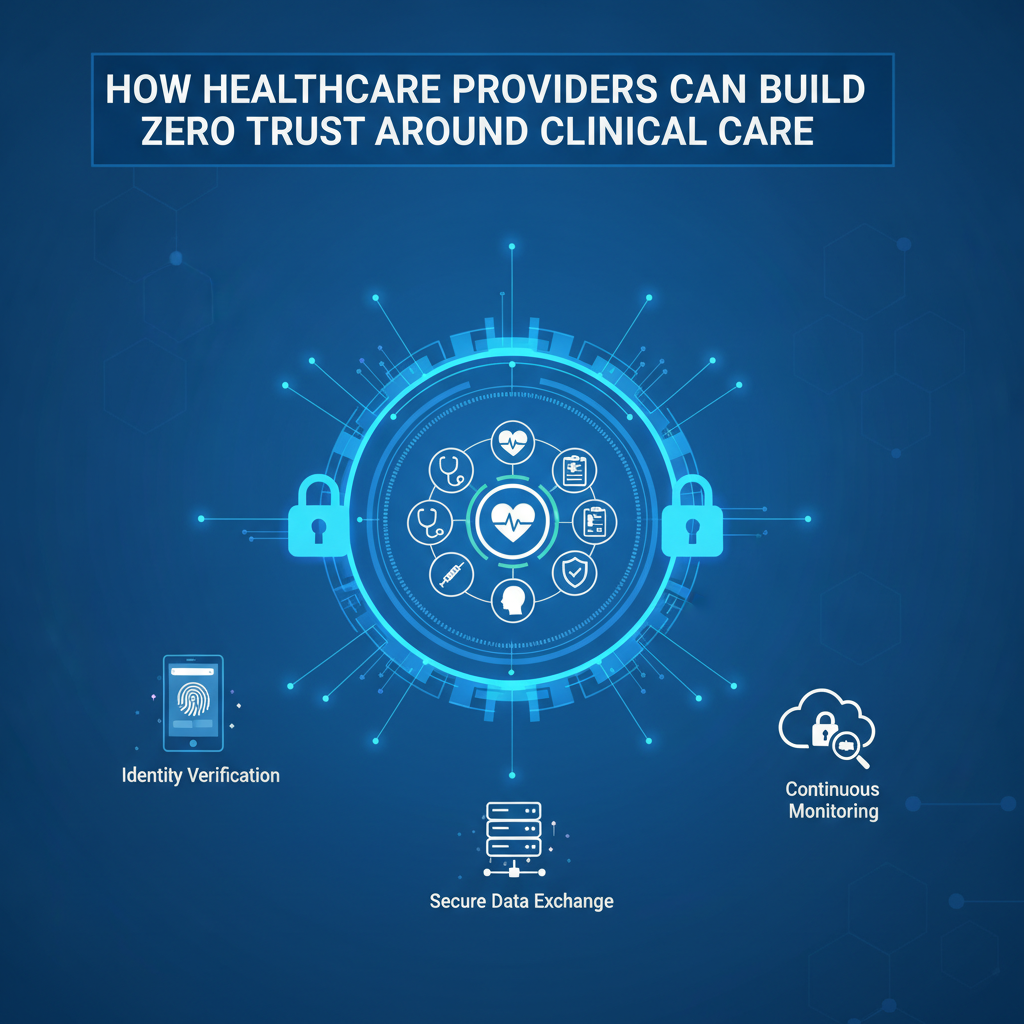
The U.S. Department of Health and Human Services describes healthcare zero trust as a coordinated effort spanning identity, devices, networks, data, workloads, visibility, and orchestration. Buyers should therefore avoid reducing the project to a single secure access service edge appliance, identity platform, or network segmentation tool.
Use cases can be prioritized by tracing actual clinical workflows:
- EHR access from shared nursing-station workstations
- Remote access for physicians and revenue-cycle staff
- Vendor maintenance of imaging, laboratory, and pharmacy systems
- Communication between infusion pumps, monitoring systems, and clinical servers
- Privileged administrator access to Microsoft Active Directory, databases, and hypervisors
- Data exchange through HL7 interfaces, FHIR APIs, and secure file transfer
Asset inventories are often the sticking point. A configuration management database may list servers and laptops while omitting older medical devices, embedded operating systems, and interfaces maintained by third parties.
Build an Evaluation Scorecard Around Access Decisions
What information will determine whether a request is allowed, denied, or challenged?
A useful scorecard examines how each prospective platform collects identity, endpoint, network, workload, and data signals. For identity, that may include SAML 2.0, OpenID Connect, OAuth 2.0, FIDO2 security keys, and integration with Active Directory or a cloud identity provider. Device controls may inspect encryption status, endpoint detection coverage, operating-system version, certificate validity, and mobile-device-management enrollment.
Healthcare-specific evaluation should also test whether policies can differentiate among job functions. HealthTech Magazine has noted that doctors, nurses, and laboratory technicians require different application access. A role-based policy might permit a laboratory technician to enter results while preventing access to billing records, but context should refine that role further. An unmanaged device, unusual location, or impossible-travel alert could trigger stronger authentication or a read-only session.
Buyers considering advisory or managed support can ask Apex Technology Services to map these requirements to existing identity, endpoint, firewall, and monitoring investments. The practical question is whether current Microsoft, Palo Alto Networks, Claroty, or other controls can exchange policy and telemetry through supported APIs, not whether one vendor can replace the entire security stack.
The scorecard should include a live proof of concept. Test access from a managed laptop, an unmanaged tablet, a shared workstation, and a vendor support account. Confirm that policy decisions and denial reasons appear in SIEM logs through syslog, API ingestion, or a native connector.
Plan the Rollout Around Clinical Dependencies
An initial discovery phase should identify applications, service accounts, device classes, data flows, and third-party connections. A 60-to-90-day discovery window can be a reasonable planning assumption for a mid-market provider, although the actual duration depends on the quality of its asset inventory and interface documentation.
During policy design, the security architect, identity engineer, network engineer, clinical informatics lead, biomedical engineering representative, and privacy officer should review proposed controls together. That team composition matters because an apparently suspicious connection may be a legitimate HL7 feed, DICOM image transfer, or medical-device callback.
The first enforcement phase can focus on a bounded workflow, such as remote EHR access. Conditional access can require phishing-resistant MFA, a managed device certificate, current endpoint protection, and an approved geographic region. Break-glass accounts should remain available for clinical emergencies, with short-lived credentials and immediate SIEM alerts whenever they are used.
A later phase can introduce micro-segmentation. Rather than allowing unrestricted traffic across a clinical VLAN, policy can permit a medical device to reach only its required DNS, NTP, management, and application endpoints on specified TCP or UDP ports. Peer-reviewed healthcare security research available through PubMed Central emphasizes continuous authentication, monitoring, and micro-segmentation as mechanisms for restricting lateral movement.
Apex Technology Services can support this phase by documenting firewall rules, identity dependencies, REST API connections, rollback procedures, and ownership for each policy. That documentation becomes particularly valuable when an EHR upgrade changes a service account, certificate, or application endpoint.
Measure Decisions, Not Product Deployment
A completed software installation says little about whether zero trust is working. Buyers should establish a baseline before enforcement and then monitor observable policy behavior.
Useful measures include the number of unmanaged-device sessions blocked, dormant privileged accounts disabled, third-party credentials with expiration dates, and applications covered by conditional access. Network teams can count permitted paths between device VLANs before and after segmentation. Security operations can track how long it takes to revoke access when a contractor leaves or an endpoint falls out of compliance.
Clinical impact deserves equal attention. Monitor repeated authentication prompts, help-desk tickets related to MFA, break-glass account usage, and login latency at shared workstations. If controls add friction during medication administration or emergency intake, the policy may need different session durations, badge-tap authentication, or workstation-specific exceptions.
While organizations often do not publicly disclose specific implementation metrics for security reasons, buyers should treat directional improvements, such as same-day access revocation or fewer unrestricted device connections, as operational targets to validate through their own SIEM, identity, and service-desk data.
Apply the Lessons to the Buying Process
Policy simulation is more informative than a feature checklist. Running prospective rules in report-only mode can reveal service accounts, legacy devices, and shared terminals that would otherwise be blocked during enforcement.
Medical-device discovery also needs separate attention. Standard endpoint agents often cannot run on an infusion pump or imaging controller, so posture may need to come from passive network monitoring, device certificates, switch telemetry, or a clinical IoT security platform.
Granted, zero trust does not eliminate exceptions. It makes them visible. Each exception should identify an owner, permitted source, destination, protocol, expiration date, and compensating control rather than remaining as a broad firewall rule indefinitely.
Broader Applicability
Regional hospitals, specialty clinics, and multi-site physician groups can adapt the same model by starting with remote EHR access or third-party support. Larger health systems may extend it to DICOM archives, cloud workloads, research environments, and cross-organization FHIR exchanges.
How long does a healthcare zero-trust rollout take?
A bounded use case may move from discovery to controlled enforcement over several months, while an enterprise program commonly proceeds through multiple budget cycles. Buyers should request phase-level estimates for identity integration, device discovery, policy testing, micro-segmentation, and SIEM onboarding rather than accepting one completion date.
What is the difference between zero trust and network segmentation?
Network segmentation restricts communication between systems or zones, often through VLANs, firewalls, or software-defined policies. Zero trust is broader: it combines segmentation with identity, device posture, application context, data sensitivity, continuous monitoring, and per-session access decisions.
Is zero trust practical for a small healthcare IT team?
Yes, if the scope begins with a defined workflow rather than the entire environment. A small team can start with MFA and conditional access for remote EHR sessions, retain at least 90 days of authentication logs for analysis, and add medical-device segmentation after validating application dependencies.